Operations Leadership:The Invisible Heartbeat of Sustainable Success
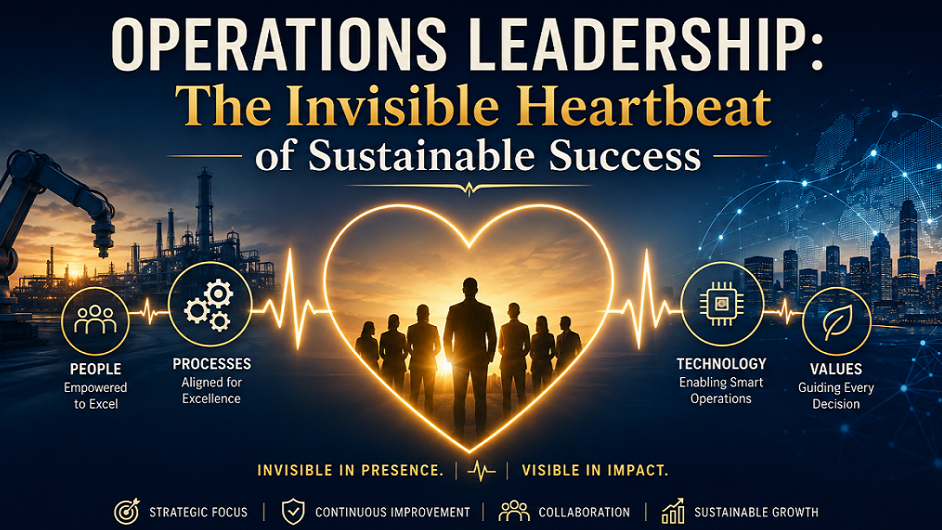
Invisible in presence.
Visible in impact.
In this article
"Operations are powered by processes, but they are sustained by Leadership. The most effective operations leaders are often the least visible—yet their influence is reflected in every successful outcome."
The core idea
Every successful organization is built upon one fundamental foundation - its operations. Whether in manufacturing or service industries, operations are the invisible engine that transforms ideas into value and commitments into customer satisfaction.
Behind every efficient operation lies something even more fundamental: Leadership.
Operations Leadership is not simply about managing activities or supervising people. It is about creating an environment where systems function seamlessly, people perform with purpose, technology enables excellence and continuous improvement becomes part of the organizational culture.
This invisible influence is the heartbeat that sustains organizational success.
At a glance
- 01Operational excellence is not about doing more work—it is about creating better systems.
- 02Competence builds performance; character builds sustainability.
- 03AI amplifies intelligence, but integrity determines its value.
- 04Leadership is measured not by authority, but by the people it empowers.

01The Foundation of Operations
Operations exist in every organization, regardless of industry.
In manufacturing, operations transform raw materials into finished products. In service organizations, they transform knowledge, information, expertise, and customer interactions into valuable outcomes.
Although the nature of the work differs, the principles remain the same. Every operation depends on the effective coordination of:
- People
- Processes
- Resources
- Technology
- Information
- Time
In manufacturing, these resources are often represented by the three Ms:
- MMan
- MMachine
- MMaterial
In service industries, technology, information, infrastructure, and expertise become equally important resources.
Regardless of the industry, each element must come together at the right time, in the right quantity, and with the right quality. A delay, communication gap, resource shortage, or process deviation at any stage can affect productivity, quality, cost, customer experience, and ultimately organizational performance.
Whenever an operation does not perform as expected, the responsibility of an operations leader is not merely to restore normalcy but to understand why the deviation occurred.
This requires evaluating:
- Process effectiveness
- Quality of outputs
- Resource utilization
- Process capability
- Downstream impact
- Customer expectations
Operational excellence is not about doing more work—it is about creating better systems.

02The Leader Behind the Process
An operations leader cannot rely solely on experience. As technology, regulations, customer expectations, and business environments evolve, the leader must evolve as well.
Continuous learning is no longer optional—it is a professional responsibility.
An effective operations leader continually develops:
- Technical competence
- Business understanding
- Leadership capability
- Digital and AI literacy
- Decision-making skills
- Communication and collaboration
However, knowledge alone is never enough.
Moral and ethical values are the foundation of sustainable Leadership.
Integrity, honesty, accountability, transparency, fairness, and respect create trust throughout the organization.
A leader who combines competence with character becomes more than an operations manager—they become a custodian of the organization's culture and long-term success.

03The Essence of Operations Leadership
Operations Leadership is not about constant supervision.
It is about continuous engagement.
The responsibility of an operations leader revolves around four continuous disciplines:
-
Remaining closely connected with the operation without unnecessary interference.
-
Detecting deviations before they become problems.
-
Identifying root causes rather than treating symptoms.
-
Continuously refining systems, processes, and capabilities.
These activities never end.
They create a cycle of learning, adaptation, innovation, and operational excellence.
The best operations leaders are often those whose influence is least visible because the systems they build function consistently without constant intervention.

04AI in Operations: Intelligence Requires Integrity
Artificial Intelligence is transforming modern operations.
From real-time monitoring and predictive maintenance to quality assurance, demand forecasting, workflow optimization, and decision support, AI enables organizations to operate faster and smarter.
However, AI is only as reliable as the information it receives.
Accurate, reliable, timely, and transparent data are the foundation of meaningful AI-driven decisions.
Poor-quality data produces poor-quality insights.
This creates a shared responsibility across the entire organization.
Every individual involved in the operational process must ensure that the information they generate is accurate, complete, and transparent.
Data integrity is not simply a technical requirement—it reflects the integrity of the people who create and manage it.
For AI to become a true operational advantage, teams must be aligned with values such as:
- Honesty
- Integrity
- Accountability
- Transparency
- Ethical responsibility
Technology can analyze data.
Only people can ensure the data deserves to be trusted.
The future of operational excellence lies in the intelligent integration of people, processes, technology, and values.

05Inspiring Rather Than Managing
Great operations leaders are not remembered because they controlled people.
They are remembered because they inspired them.
They develop ownershipinstead ofdependency.
They encourage collaborationinstead ofhierarchy.
They build future leadersinstead offollowers.
Their success is reflected in empowered teams, resilient processes, satisfied customers and an organizational culture that continuously improves itself.
They are the torchbearers of the process.
By holding the light of knowledge, ethics, and purpose higher, they enable every level of the organization to see more clearly, think more responsibly, and perform more effectively.
Their Leadership may remain invisible.
Its impact never does.
06Conclusion
When Leadership becomes the heartbeat of operations, sustainable success becomes the rhythm of the organization.
Operational excellence is not achieved by systems alone, nor by people alone.
It is created through the harmonious integration of people, processes, technology, continuous learning, and ethical Leadership.
An operations leader keeps this integration alive through continuous engagement, monitoring, evaluation, learning, and improvement.
Artificial Intelligence will continue to transform operations, but its effectiveness will always depend on the integrity of the people, the reliability of the data, and the values that guide every decision.
Like a heartbeat, operations Leadership is rarely noticed when everything functions well.
Yet it is this invisible heartbeat that keeps every process flowing, every team aligned, every decision purposeful, and every organization moving toward sustainable success.
- Operations succeed through systems.
- Organizations grow through people.
- Technology accelerates progress.
- Values sustain trust.
- Leadership brings them all together.
That is why Operations Leadership is the invisible heartbeat of sustainable success.
